


If July is when summer disease shows up, August is when it decides whether or not it’s going to win. By now your greens have been under heat stress for six to eight consecutive weeks. Root systems are shallow, carbohydrate reserves are depleted, and the plant’s ability to recover from any setback — whether it’s a disease outbreak, a wilt event, or a rough mowing — is at its lowest point of the year.
This is not the month to experiment, to cut corners on scouting, or to skip a fungicide interval because ‘it looks okay right now.’ This is the month you manage to protect what you’ve held onto all summer and set yourself up for a clean transition into fall.
AUGUST AT A GLANCE — WHAT’S ON YOUR RADAR
- Wilt watching and moisture management as soil temps peak
- Syringing strategy — when, how much, and why it matters
- Late-season Pythium, Brown Patch, and Dollar Spot pressure
- Spoon-feeding nitrogen without pushing vulnerable growth
- Biostimulant timing to support root recovery ahead of fall
- Preparing the cultural calendar for transition season
Wilt is not a disease — but it opens the door wide for the ones that are. A wilting plant has compromised cell turgor, reduced cuticle integrity, and is far more susceptible to fungal penetration. Managing wilt in August is one of the most direct disease-prevention tools you have.
How to Read Wilt Before It Becomes Visible Stress
By the time turf shows the classic blue-grey wilt color or footprinting, the plant has already been under significant stress for hours. The best superintendents are scouting for pre-wilt indicators:
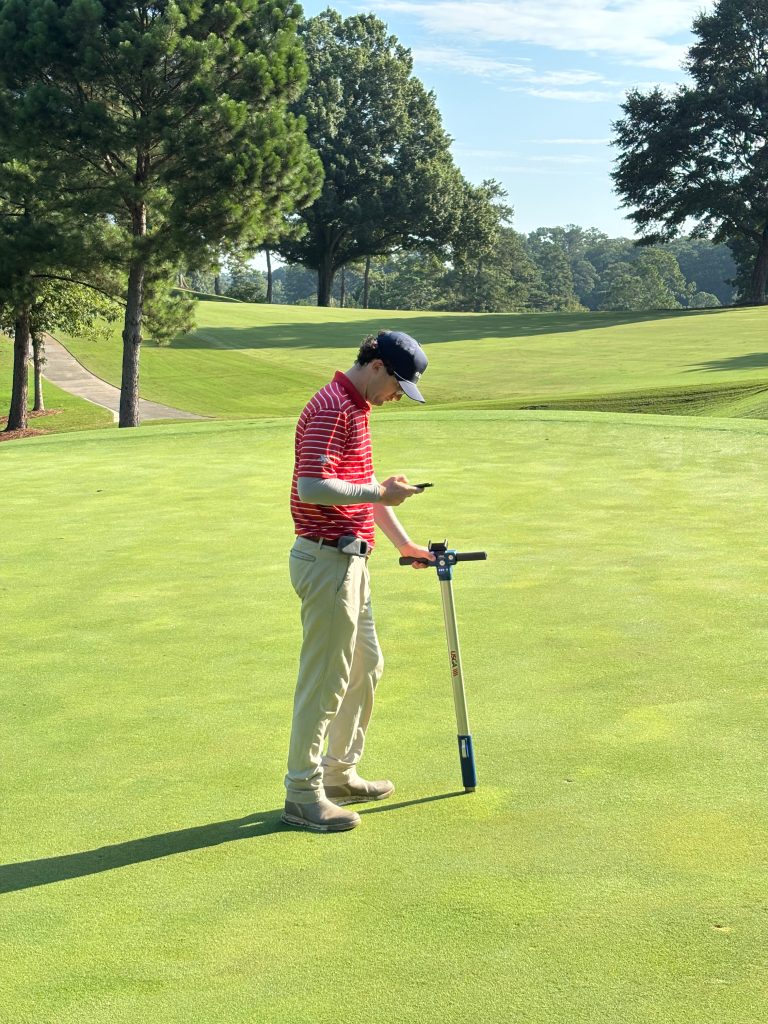
- Morning moisture meter readings — flag any zones tracking below threshold before 8 AM
- Watch for the leading edge of wilt to appear first on mounds, south-facing slopes, and areas near sand bunkers or hard cart paths that radiate heat
- Check the forecast before sunrise — if air temperatures are above 90°F with dew points above 70°F, plan for hand-watering before the heat sets in
- Footprinting that doesn’t recover within 15 minutes is your first actionable wilt signal
Bermudagrass Wilt vs. Bentgrass Wilt — Different Responses Required
| Bermudagrass (Ultradwarf) | Creeping Bentgrass |
Wilt trigger | High night temps depleting carbohydrate reserves; soil temps above 95°F at surface | Soil temps above 80–85°F at 2″ depth; accumulated heat stress reducing root depth |
How it looks | Blue-grey cast, footprinting, leaf rolling; can appear sudden after midday | Slow to recover from footprinting; yellowing patches; soft, spongy feel under foot |
Response | Syringe to cool canopy; do NOT over-irrigate — wet soil + heat = Pythium risk | Light syringe to cool crown; improve airflow; avoid any additional stress (mowing, rolling) during peak heat |
Key tool | Moisture meter + IR thermometer — check surface temps, not just soil moisture | Moisture meter at 2″ depth + daily canopy temp readings 11 AM – 2 PM |
Syringing is one of the most powerful and most misused tools in an August program. Done right, it saves turf. Done wrong, it creates the exact warm, wet canopy environment that Pythium blight turns into a buffet.
The Goal of Syringing
Syringing is about canopy temperature reduction, not soil moisture replenishment. A proper syringe application puts just enough water on the leaf to lower the canopy temperature by 8–12°F through evaporative cooling. It is not an irrigation event.
SYRINGING FIELD PROTOCOL — AUGUST
- Timing: 11 AM – 2 PM when canopy temps exceed 95°F or wilt indicators appear
- Volume: Light, uniform pass — enough to visibly wet the leaf surface without puddling
- Frequency: As needed by canopy temp — not on a fixed schedule, and never after 4 PM
- Monitor: Use an IR thermometer before and after — target a 10°F surface reduction
- Avoid: Syringing into the evening or at night — prolonged leaf wetness feeds disease
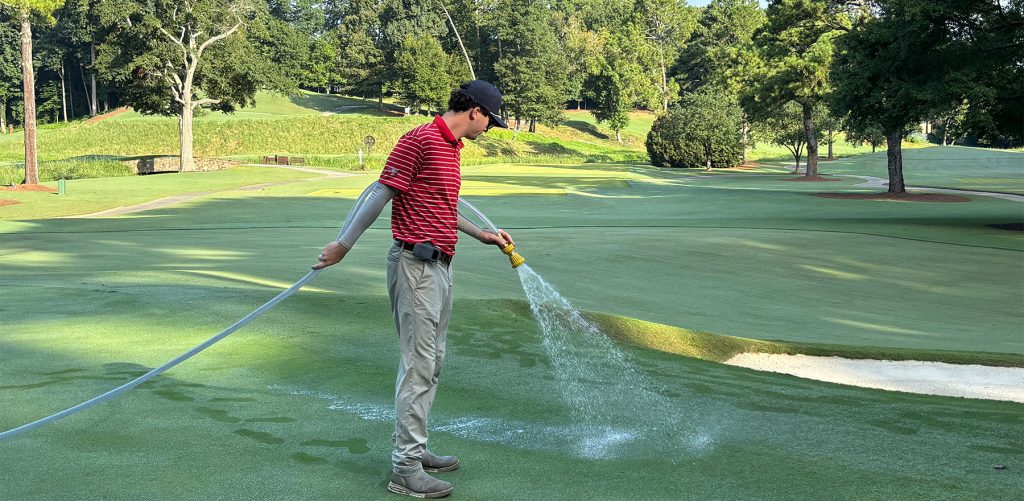
- Hand-watering: Target individual stressed areas rather than running full heads to wet the whole green
July’s disease triangle doesn’t pack up in August — it intensifies. High soil temperatures, accumulated plant stress, and the continuation of warm, humid nights keep all four of the major summer pathogens active. Here’s what to be scouting for right now.
Pythium Root Rot — The August Version
August Pythium is different from the blight that shows up in late June and July. By August you’re more likely to see Pythium root rot and root dysfunction — a slower, less dramatic decline where turf thins and loses vigor without the overnight collapse of blight. Roots appear brown, stunted, and lack white healthy tips. This version is harder to identify and easier to misattribute to heat stress alone.
ID tip: Pull a cup cutter sample and examine roots. Healthy Bent roots are white and reach 3–4″+. August Pythium root rot roots are brown, mushy, and often only 0.5–1″ long. This is the diagnosis.
Brown Patch — Still Active, Still Hungry
Brown patch remains active through August wherever night temperatures hold above 70°F and humidity lingers. In Bentgrass it’s particularly aggressive in areas with poor air circulation. The smoke ring diagnostic symptom fades quickly after sunrise — walk greens before 8 AM to catch it.
Dollar Spot — The Nitrogen Signal
If you’re still seeing dollar spot push in August, treat it as a soil fertility signal. Dollar spot in August almost always means the nitrogen program has been too conservative. A targeted light application of foliar nitrogen (0.1 lb N/1000 sq ft) alongside a contact fungicide is often more effective than a fungicide application alone.
Anthracnose Basal Rot — The Long Game
Anthracnose in August is cumulative stress disease — it targets the turf that has been running under nitrogen deficit, compaction, or scalping stress for weeks. Look for the characteristic yellow-bronze discoloration and black acervuli (tiny pin-head fruiting bodies) along the stem at the soil line. An SDHI + DMI application combined with a nitrogen adjustment and aeration relief is the most effective combined response.
Fungicide applications in August are working with a weakened host — a plant that has less energy to partition toward recovery. This makes preventive timing more critical than ever. If you’re applying curatively in August you’re always a step behind.
FRAC Rotation — Keeping Your Chemistry Effective
Application | Product Type | FRAC Group | Target Disease | Interval |
App 1 | SDHI + DMI Combo | FRAC 7 + FRAC 3 | Anthracnose, Dollar Spot, Brown Patch | 14–21 days |
App 2 | Contact (Multi-site) | FRAC M (multi) | Broad spectrum preventive | 7–10 days |
App 3 | QoI / SDHI Combo | FRAC 11 + FRAC 7 | Pythium, Brown Patch | 14–21 days |
App 4 | Phosphonate / Systemic | FRAC P7 | Pythium root rot / blight | 14 days |
Golden rule: never repeat the same FRAC group in consecutive applications. Track by FRAC code in your spray log — not product name.
August is not the month to push nitrogen. It is the month to maintain it — precisely, lightly, and frequently. The goal is to keep the plant in a nutritionally stable state without triggering a flush of soft, disease-susceptible growth during the most stressful weeks of the year.
The Spoon-Feeding Framework
- Rate: 0.05–0.10 lb N/1000 sq ft per application — no single application over 0.15 lb
- Frequency: Every 7–14 days depending on growth rate, color, and disease pressure
- Form: Foliar liquid applications preferred — root uptake is compromised by high soil temps and shallow root systems
- Partner: Always include potassium (K) at a 1:1 or 2:1 K:N ratio to support cell wall strength and drought/heat tolerance
- Avoid: Any granular quick-release N source in August — too much risk of burn and uneven uptake on stressed turf
THE AUGUST N RULE OF THUMB
If you’re seeing dollar spot, add a light N application. If you’re seeing brown patch or Pythium, pull back on N and focus on cultural drydown. The disease tells you what the plant’s nutrition situation is — listen to it.
August is the ideal month to incorporate biostimulant products into your program — not as a replacement for sound agronomy, but as a complement to it. When the plant’s root system is shallow and carbohydrate reserves are depleted, biostimulants can make a meaningful difference in recovery rate and stress tolerance.
What to Look For in an August Biostimulant Program
- Seaweed / kelp extracts — contain cytokinins that support cell division and root elongation at depth
- Humic and fulvic acids — improve nutrient uptake efficiency when root function is already limited
- Amino acid complexes — provide plant-available nitrogen and stress-tolerance compounds without pushing growth
- Mycorrhizal inoculants — consider applications ahead of fall aeration to maximize colonization timing
- Silicon — strengthens cell walls and improves heat, drought, and disease resistance across both warm and cool-season species
August is a conservation month. Every cultural decision should be evaluated first through the lens of ‘does this add stress to an already-stressed plant?’ If the answer is yes, it waits until September.
What to Do
- Walk greens daily — morning scouting is your most valuable 20 minutes every day this month
- Roll instead of mow on the most stressful days — maintains speed without the additional wounding stress of a blade cut
- Keep mower blades razor-sharp — dull blades shred tissue and create ideal disease entry points
- Manage thatch actively — light topdressing with compatible sand keeps surfaces firm and reduces the moisture retention that feeds disease
- Maintain fan operation around the clock on greens with compromised airflow
- Spot-treat localized dry areas with penetrant wetting agents — never over-irrigate the whole green to fix a hot spot
What to Hold Until September
- Deep-tine or solid-tine aeration — wait until soil temps drop below 80°F at 2″ depth
- Aggressive verticutting or grooming — unnecessary wounding on a stressed plant
- Any significant fertility rate increase — hold until the plant is in recovery mode, not survival mode
- Overseeding programs — timing is critical and August soil temps are still too high for reliable germination in most Southeast regions
August doesn’t last forever. The goal right now is to exit this month with greens that are ready to respond when temperatures break — typically mid-to-late September in most Southeast markets. Here’s what that exit checklist looks like:
- Fungicide program current and FRAC-rotated through the end of August
- Nitrogen program adjusted and documented — ready to step up rates as soil temps moderate
- Aeration timing confirmed — schedule for the first window soil temps drop below 80°F
- Biostimulant program in place to support root recovery through transition
- Overseeding plan locked — variety selection, seeding rates, and timing confirmed for cool-season transitional markets
Your Central Pro Supply Team Is With You
August is the toughest month of the year on a putting green. But it’s also the month where the right program, the right products, and the right partner make the biggest difference. Your Central Pro Supply rep can help you source SDHI/DMI combinations, contact fungicides, biostimulant programs, and fertility solutions built for August conditions.